What ‘Escape Velocity’? March Non-Oil Trade Deficit Highest In History

By ZeroHedge

Remember that in a beggar thy neighbor world, where currency warfare has once again broken out between the US, Europe and Japan, for every winner there is a loser. In this case, the loser is the one country that has decided that a strong currency is a great thing for its economy (if only for the time being): that would be the US.

Why is this relevant? Because as the chart below shows, US trade excluding Petroleum, just crashed to $43.7 billion, the worst print in the history of the series, suggesting that portrayals of the US as a resurgent export powerhouse are completely erroneous, and that instead the US is as big a net importer of goods and services (and soon to be oil) as ever.

Biggest ever trade deficit (ex Petroleum)

The crucial point here is that with Shale production now expected to decline (if only modestly: after all those junk bond investors are desperate to keep the MotherFracking dream alive), the US will soon have to import more oil which will require more debt issuance to fund the soaring trade deficit which will require more QE to monetize the deficit.

And thus the stage is set for QE4.

One thing is sure – if the trade deficit surge continues, and Q1 GDP tumbles below 0%, the Fed will be right back at the frontlines, CTRL-Ping the US economy right back into “beggar thy global neighbor”competitiveness. Because as we noted, with Q1 GDP now assured a negative print, and with Q2 GDP according to the Atlanta Fed at 0.8% and likely going lower if there are several “unexpected” spring showers, the US may enter a technical recession as soon as June 30.

Hardly the stuff rate hikes are made of...
16 Signs That The Economy Has Stalled Out And The Next Economic Downturn Is Near

By Michael Snyder at the Economic Collapse Blog If U.S. economic growth falls any lower, we are officially going to be in recession territory.  On Wednesday, we learned that U.S. GDP grew at a 0.2 percent annual rate in the first quarter of 2015.  That was much lower than all of the “experts” were projecting.  […]
You must be a Stockman's Corner member in order to view this post, subscribe to Monthly Subscription, Quarterly Subscription or Annual Subscription.
Login or Join Now To Read More

Half Of Frackers Will Be Gone By Year-End, Top Industry CEO Warns

by ZeroHedge

Following the CEO’s comments that over 100,000 energy jobs will be lost this year, an executive with Weatherford International – the fifth largest US fracker – has warned half of the 41 fracking companies operating in the U.S. will be dead or sold by year-end because of slashed spending by oil companies. “We go by and we see yards are locked up and the doors are closed,” said Rob Fulks, seemingly confirming what Weatherford CEO Duroc-Danner said earlier in the year, “we’re now confronted with an unusually severe market contraction.”


As Bloomberg reports, there were 61 fracking service providers in the U.S., the world’s largest market, at the start of last year. Now there are 41… and it’s going to get a lot less…

Half of the 41 fracking companies operating in the U.S. will be dead or sold by year-end because of slashed spending by oil companies, an executive with Weatherford International Plc said.

There could be about 20 companies left that provide hydraulic fracturing services,Rob Fulks, pressure pumping marketing director at Weatherford, said in an interview Wednesday at the IHS CERAWeek conference in Houston. Demand for fracking, a production method that along with horizontal drilling spurred a boom in U.S. oil and natural gas output, has declined as customers leave wells uncompleted because of low prices…

Weatherford, which operates the fifth-largest fracking operation in the U.S., has been forced to cut costs “dramatically” in response to customer demand, Fulks said. The company has been able to negotiate price cuts from the mines that supply sand, which is used to prop open cracks in the rocks that allow hydrocarbons to flow.

Oil companies are cutting more than $100 billion in spending globally after prices fell. Frack pricing is expected to fall as much as 35 percent this year, according to PacWest, a unit of IHS Inc.

“We go by and we see yards are locked up and the doors are closed,” he said. “It’s not good for equipment to park anything, whether it’s an airplane, a frack pump or a car.”

*  *  *

While ‘stability’ in oil prices remains the status quo, it appears the industry cannot manage on that alone (and given the pricing of recent resource-related junk bond offerings, they will not have the luxury of cheap financing to enable them to keep running).

Half Of US Frackers Will Be Dead By Year End, Weatherford Warns | Zero Hedge.

Central Banking Refuted In One Blog—–Thanks Ben!

Blogger Ben’s work is already done. In his very first substantive post as a civilian he gave away all the secrets of the monetary temple. The Bernank actually refuted the case for modern central banking in one blog. In fact, he did it in one paragraph. This one. A similarly confused criticism often heard is that the […]
You must be a Stockman's Corner member in order to view this post, subscribe to Monthly Subscription, Quarterly Subscription or Annual Subscription.
Login or Join Now To Read More

5 Charts Which Show That The Next Economic Crash Is Dead Ahead

By Michael Snyder

When an economic crisis is coming, there are usually certain indicators that appear in advance.  For example, commodity prices usually start to plunge before a recession begins.  And as you can see from the Bloomberg Commodity Indexwhich you can find right here, this has already been happening.  In addition, I have previously written about how the U.S. dollar went on a great run just before the financial collapse of 2008.  This is something that has also been happening over the past few months.  Some people would have you believe that nobody can anticipate the next great economic downturn and that to try to do so is just an exercise in “guesswork”.  But that is not the case at all.  We can look back over history and see patterns that keep repeating.  And a lot of the exact same patterns that happened just before previous stock market crashes are happening again right now.

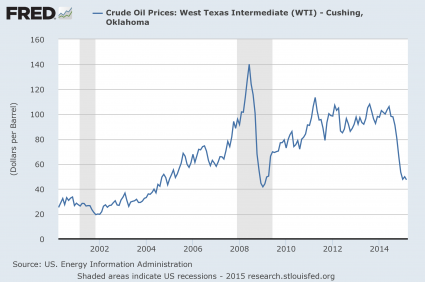
For example, let’s talk about the price of oil.  There are only two times in history when the price of oil has fallen by more than 50 dollars in a six month time period.  One was just before the financial crisis in 2008, and the other has just happened…

Price Of Oil 2015

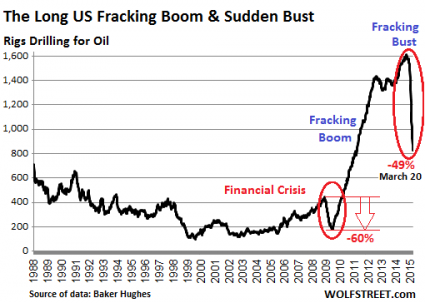
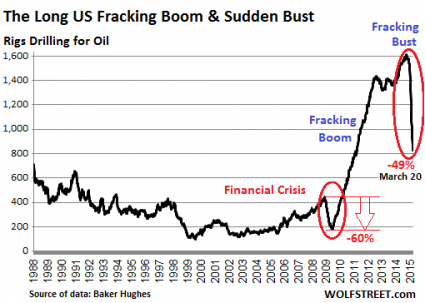
As a result of crashing oil prices, we are witnessing oil rigs shut down in the United States at a blistering pace.  In fact, almost half of all oil rigs in the U.S. have already shut down.  The following commentary and chart come from Wolf Richter

In the latest week, drillers idled another 41 oil rigs, according to Baker Hughes. Only 825 rigs were still active, down 48.7% from October. In the 23 weeks since, drillers have idled 784 oil rigs, the steepest, deepest cliff-dive in the history of the data:

Fracking Bust 2015

We are looking at a full-blown fracking bust, and this bust is already having a dramatic impact on the economies of states that are heavily dependent on the energy industry.

For example, just check out the disturbing number that just came out of Texas

The crash in oil prices is hammering the Texas economy.

The latest manufacturing outlook index from the Dallas Fed plunged again in March, to -17.4 from -11.2 in February, indicating deteriorating business conditions in the state.

Ouch.

But this pain is going to be felt far beyond Texas.  In recent years, Wall Street banks have made a massive amount of money packaging up energy industry loans, bonds, etc. and selling them off to investors.

If that sounds similar to the kind of behavior that preceded the subprime mortgage meltdown, that is because it is.

Now those loans, bonds, etc. are going bad as the fracking bust intensifies, and whoever is left holding all of this worthless paper at the end of the day is going to lose an extraordinary amount of money.  Here is more from Wolf Richter

It suited Wall Street just fine: according to Dealogic, banks extracted $31 billion in fees from the US oil and gas industry and its investors over the past five years by handling IPOs, spin-offs, “leveraged-loan” transactions, the sale of bonds and junk bonds, and M&A.

Login or Join Now To Read More

After $31 Billion Fee Bonanza——Wall Street Gets Indigestion On Busted Energy Loans

By MATT WIRZ and GILLIAN TAN at The Wall Street Journal

Citigroup Inc.,Goldman Sachs Group Inc.,UBS AG and other large banks face tens of millions of dollars in losses on loans they made to energy companies last year, a sign of investor jitters in a sector battered by the oil slump.

The banks intended to sell the loans to investors but have struggled to unload them even after cutting prices, thanks to a nine-month-long plunge that has taken Nymex crude futures to their lowest level since 2009.

The losses mark a setback for Wall Street, after global banks earned $31 billion in fees over the past five years by financing energy-company stock sales, borrowing and mergers-and-acquisition transactions, according to Dealogic.

Wall Street’s losses on the loans could have a chilling effect on some oil companies’ ability to fund their operations as investors take a more cautious view of the sector.

“We’ve been pretty shy about dipping back into the energy names,” said Robert Cohen, a loan-portfolio manager at DoubleLine Capital who passed on some loans Citi was trying to sell. “We’re taking a wait-and-see attitude.”

Energy-sector deals have been a bright spot at a time when once-lucrative businesses, such as fixed-income trading and consumer lending, are flagging thanks to tighter rules, low interest rates and uneven economic growth, analysts said.

Investors say the energy bust doesn’t pose a great risk to the banks akin to 2007-2008, when they held hundreds of billions of dollars of souring mortgages and corporate loans.

“We often go through these periods,” said Sherif Hamid, vice president of high yield at AllianceBernstein LP, who helps oversee $35 billion of investments. “We saw it in Europe during the sovereign crisis where banks needed to sell at prices where buyers were willing to step in, even if it meant taking a loss, but it doesn’t mean the market is closed.”

At the same time, Wall Street hasn’t struggled to place so many corporate loans at once since credit markets seized up in 2007, when banks were stuck with more than $150 billion of so-called leveraged loans to companies with credit ratings below investment grade. Banking regulators have repeatedly sounded alarms about lax lending standards and are proposing to force banks to submit their loan portfolios more frequently for risk exams.

The losses show the danger banks face when unforeseen events, like the sharp drop in oil prices, create a chain reaction across an industry.

Investment banks helped fuel the oil-and-gas exploration boom of the past decade by making loans valued at about $1 trillion to companies in the energy industry, most of which they sold to investors.

The banks sold much of the debt to loan mutual funds, which grew rapidly from 2011 to 2013, but that demand dwindled as individual investors yanked $35 billion from the funds over the last 12 months, according to S&P Capital IQ LCD.

In June, Citigroup committed to a $1.3 billion loan backing an acquisition for Houston-based C&J Energy Services Inc. When Citi tried to sell the loan in November with Bank of America Corp.,… Login or Join Now To Read More

Cogitations On The US Dollar——-Shorts, Highs, Plentitudes

it is actually not correct to speak of a "dollar shortage". The domestic dollar money supply has more than doubled since 2008, and a large additional amount of dollar creation has "escaped" into accounts held abroad. (The dollar money supply outside of the US has also increased greatly). It is not a shortage of dollars, but a growing unwillingness of dollar holders to lend them out that creates a problem for banks in need of dollar funding. Login or Join Now To Read More

Connecting The Dots—-Oil, Jobs And Consumer Confidence

Politicians, Wall Street, and the Federal Reserve Bank want you to think the economy is doing great thanks to the big improvements in the labor market.

However, Janet Yellen, who testified before the Senate Banking Committee last week, admitted that the labor market isn’t so rosy.

“Too many Americans remain unemployed or underemployed, wage growth is still sluggish, and inflation remains well below our longer-run objective,” said Yellen.

What Yellen is trying to say in her special brand of Fedspeak double-talk is that the job situation is going to get worse.

There are currently 30 million unemployed or severely underemployed Americans and I doubt that many of them are celebrating the drop in the unemployment rate.

Case in point: Take a look at the oil industry.

One of the biggest drivers of recent job growth was the oil industry, thanks to improvement in fracking technology.

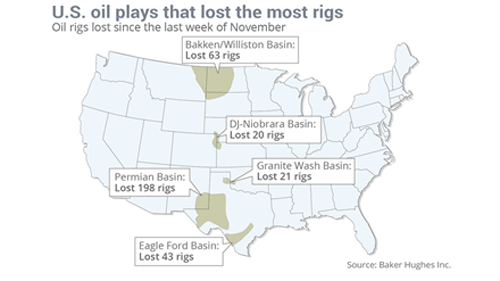
The collapse in crude prices has sidelined hundreds of oil- and gas-drilling rigs in recent months. Some 1,300 rigs are active through February 13 in the US and Canada, down 30% from about 1,860 rigs in November 2014.

Energy consulting company Wood Mackenzie predicted that another 15% of oil rigs will be idled by the summer. Drilling rigs “are currently being stacked at an alarming rate,” said Scott Mitchell of Wood Mackenzie.

Staffing firm Challenger, Gray & Christmas put out some actual job numbers related to the collapse of oil prices:

Job cut announcements surged to their highest level in nearly two years, as falling oil prices prompted cost-cutting efforts in energy and related industries. In all, US-based employers announced plans to shed 53,041 jobs from their payrolls to start 2015; with 40% of those directly related to oil prices.

Of the 53,041 job cuts announced in January, 21,322 were directly attributed to the recent and sharp decline in oil prices. Most of these cuts occurred in the energy industry, where employers announced a total of 20,193 layoffs. The January total is 42% higher than the 14,262 job cuts announced by the energy industry in all of 2014.

Don’t forget; these oil jobs are among some of the highest-paying blue-collar jobs in the country, so losing one oil job is like losing five or eight or ten hospitality-industry (“Would you like some fries with that, sir?”) jobs.

Maybe that’s why despite the stock market hitting all-time highs and President Obama taking economic victory laps on TV, Americans aren’t very optimistic about their futures.

The Conference Board Consumer Confidence Index dropped from 102.9 to 96.4 in February, well below the 99.4 that the Wall Street geniuses were expecting.

That’s a bomb, but the real meat of the survey was the LABOR MARKET conditions.

Jobs Plentiful? 20.5% of Americans said that jobs are “plentiful.” Sounds good, right? Wrong! That’s a decrease from January, but more importantly, the number of Americans that described jobs as “hard to get” jumped from 24.6% to 26.2% in the last month.

Jobs plentiful declined; jobs hard to get increased.Login or Join Now To Read More