Here’s What You Need to Know About Industrial Production That Big Media Didn’t Tell You
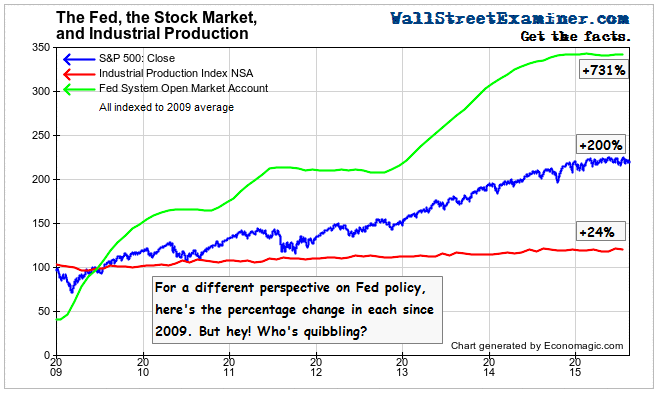
U.S. Industrial Production Ratchets Up in July trumpeted the Wall Street Journal on Friday. It added that, “Industrial production, a measure of output in the manufacturing, utilities and mining sectors, rose a seasonally adjusted 0.6% in July from June, the Federal Reserve said Friday. It was the largest gain since November and the second straight… Login or Join Now To Read More
Mind The Transports: Freight Rail Traffic Tumbles on Falling Coal, Oil Demand

By BRIAN BASKIN AND ALISON SIDER at The Wall Street Journal

Rail traffic fell in July from a year ago as an increase in container volumes couldn’t offset a steep decline in oil and coal shipments, the Association of American Railroads said in its monthly report Friday.

The number of carloads carrying oil and petroleum products dropped 13.6% from a year ago to 67,909 last month, while coal volumes sank 12.5%. Container shipments rose 3.8% to 1.2 million. Traffic overall fell 1.8% to 2.7 million, the association said.

Oil-train shipments have tumbled this year, hurt by plunging prices for crude and concerns about the safety of transporting petroleum by rail. That, plus declining demand for coal from power plants and overseas buyers, has hit railroad operators’ earnings. Norfolk Southern Corp., CSX Corp. and Union Pacific Corp. are among the major operators to attribute declining revenue to waning energy-related business.

“Railroads are overexposed, relative to the economy in general, to the energy sector,” analysts with the AAR said in the traffic report.

The intermodal transport of containers and trailers was a bright spot for the railroads in July, reflecting an expanding economy. Still, the AAR report cautioned that growth is slow and the recovery could be threatened by an interest-rate increase by the Federal Reserve, which is widely expected this fall.

The impact of declining oil prices also was evident in falling industrial sand shipping. Carloads of industrial sand, a category that includes sand used in hydraulic fracturing, were 18% lower in the second quarter compared with the second quarter of 2014. The fracking of a single shale well can involve millions of pounds of sand.

Last year, sand producers worried that demand for sand was so frenzied that there wouldn’t be enough railcars to carry it all from mines in places like Wisconsin and Illinois. Today, companies are trying to get rid of the railcars they ordered at the height of the boom.

U.S. Silica Holdings Inc., one of the country’s largest sand mining companies, said recently that it had deferred delivery of more than 2,500 new railcars to 2017 and 2018 to put off incurring costs. The company has more than 1,400 railcars in storage.

“My hope is that we’ll be able to get some cars out of storage just from getting more volume flowing through the network,” said Chief Executive Bryan Shinn during an earnings conference call last month. He added that the company is “looking for ways to delay, defer, push those railcars off to others, and we’ve been pretty successful so far in finding people to sublease some of our cars.”

Source: Freight Rail Traffic Tumbles on Falling Coal, Oil Demand – WSJLogin or Join Now To Read More

Frack Now, Pay Later—-Kicking The Can In The Shale Patch

By Nick Cunningham at Oilprice.com

With oil prices now dipping close to six-year lows, the energy sector is getting thumped across the board.

The double-dip will likely cause fresh cuts to spending, drilling, and staff. Last week, Baker Hughes reported a surprise uptick in the number of rigs drilling in North America, which jumped by 10 to 884 for the week ending on August 7.

Oil prices fell even further on the news, with both WTI and Brent dropping by 2 percent to close out the week. Even though the additional rigs are a rounding error when compared to the 1,000 rigs that disappeared over the past year, the markets took the data as evidence that the supply overhang may not balance out in the near term, as new drilling could be taking place before oil production has appreciably declined.

Over the course of the last year, the companies that arguably suffered the worst were those whose business relies on drilling activity. Oilfield service companies offer rigs, drilling completions, equipment, and other services that actually allow drilling to happen. When drilling slows down, their business dries up. They bear the brunt of a market downturn.

Related: Even The Saudis Need To Borrow To Survive Oil Price Slump

The unprecedented crash in the rig count North America, notwithstanding minor gains in recent weeks, inflicted damage most acutely on these oilfield service companies. With exploration facing a prolonged period of lower activity, a few service companies have come up with a novel, if desperate, approach to keep business alive.

Schlumberger and Halliburton, the two largest service firms, have offered operators the option to “frack now and pay later.” According to Reuters, the new offer amounts to the service firms acting as lenders to oil companies.

Halliburton saw its profit for the second quarter fall by more than a half billion dollars from a year before, and backed by $500 million in cash from asset manager BlackRock, Halliburton is looking “at additional ways of doing business with our customers,” Halliburton’s CEO Dave Lesar said recently.

Related: Global Oil Supply More Fragile Than You Think

The “frack now pay later” model that Reuters described consists of companies like Halliburton or Schlumberger covering the cost of drilling a well in exchange for a portion of the well’s production. That is not always a preferred option for operators, who may not want to give up a share in the project and would simply opt for a conventional service contract. However, for companies that are running low on cash and may start to see their credit lines shrink, paying later for drilling today sounds like a pretty good option.

Login or Join Now To Read More

The Looming Bankruptcy Of Saudi Arabia

by Tim Worstall for Forbes

There’s two interesting little stories in this idea that Saudi Arabia is going to go bust in a couple of years as a result of the sagging oil price. Both are more general economic ideas than just the story of that oil price. The first is that mono-anything in economics is something we don’t really like. We certainly don’t like either monopolies or monopsonies, but we should also be very careful of an economy that relies on any one product or even supplier. The perils of resting an entire economy on the production of just the one commodity should be obvious here. But the same could and should be said about reliance upon any one supplier in an economy as well. We want diversity, always, of producers and suppliers. The second is that this is an object lesson in why most economists don’t really believe in the idea of predatory pricing. Sure, it’s possible for a dominant supplier to try to lower prices and drive others out of the marketplace. The idea is that once they’ve bankrupted those others then they can sweep back in, raise prices and thus enjoy monopoly profits having killed the competition. There’s an element of Saudi having tried this, trying to kill off shale. And it’s not working: and economists have never really seen anyone making this tactic work. Which is why they don’t really believe in it as anything other than a theoretical possibility.

So here’s Ambrose Evan Pritchard: and it should be said, love him dearly though we do, he can be just a little over enthusiastic about his latest idea:

If the oil futures market is correct, Saudi Arabia will start running into trouble within two years. It will be in existential crisis by the end of the decade.
The contract price of US crude oil for delivery in December 2020 is currently $62.05, implying a drastic change in the economic landscape for the Middle East and the petro-rentier states.
The Saudis took a huge gamble last November when they stopped supporting prices and opted instead to flood the market and drive out rivals, boosting their own output to 10.6m barrels a day (b/d) into the teeth of the downturn.
Bank of America BAC -0.34% says OPEC is now “effectively dissolved”. The cartel might as well shut down its offices in Vienna to save money.
If the oil market had had its old structure, where projects take a decade or more to even bring into production and then produce for decades more, at vast capital cost, then the sort of tactic that Saudi used might have a chance of working. If by flooding the market for a year or two Saudi can cast doubt on the financing of the next wave of such large projects then they might be able to enjoy a decade or more of high prices. Those high prices more than making up for the lost income in that period of undercutting those projects. Maybe.… Login or Join Now To Read More

Harold Hamm’s Ham-Handed Harassment of Oklahoma Quake Study Scientists

The billionaire CEO of Continental Resources told a dean at the University of Oklahoma that he wanted earthquake researchers fired. In one of the most transparently oligarchic tactics we have seen yet during this ‘recovery’, oil tycoon Harold Hamm demanded certain scientists be dismissed following their findings that fracking wastewater disposal was the cause of the spike in Oklahoma earthquakes. Despite his protestations recently that “I don’t try to push anyone around,” as the following email obtained by Bloomberg, exposes, “Mr. Hamm is very upset at some of the earthquake reporting to the point that he would like to see select OGS staff dismissed.”

As we noted previously, no matter what other problems may or may not be linked to hydraulic fracturing, or fracking, the disposal of wastewater from oil and gas drilling almost certainly is primarily responsible for the recent spate of earthquakes in Oklahoma, normally a seismologically quiet state.

That’s the conclusion of a report issued April 21 by the Oklahoma Geological Survey (OGS), in which the state geologist Richard D. Andrews and Dr. Austen Holland, the state seismologist, said the rate of earthquakes near major oil and gas drilling operations that produce large amounts of wastewater demonstrate that the quakes “are very unlikely to represent a naturally occurring process.”

Andrews and Holland concluded that the “primary suspected source” of the quakes is not hydraulic fracturing, or fracking, in which water and chemicals are injected under high pressure to crack shale to free oil and gas trapped inside. It said the source is more likely the injection of wastewater from this process in disposal wells, because water used in fracking cannot be re-used.

“The OGS considers it very likely that the majority of recent earthquakes, particularly those in central and north-central Oklahoma, are triggered by the injection of produced water in disposal wells,” the statement said. It warned that residents should prepare for “a significant earthquake.”

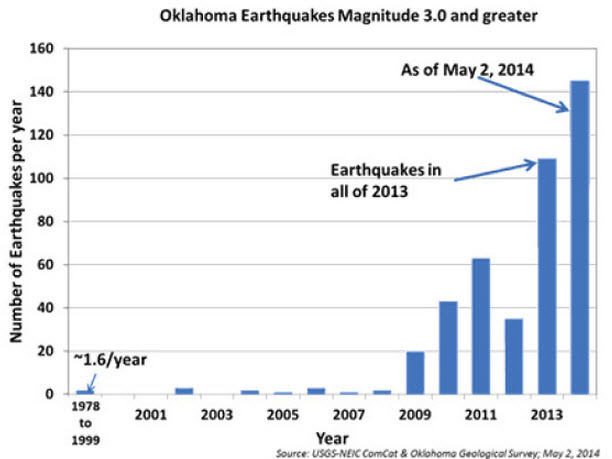
Oklahoma recorded 585 earthquakes with a magnitude of 3 or greater,the equivalent of the force felt in Oklahoma City at the time of the terrorist bombing in 1995. This is a significant increase from 109 earthquakes of the same magnitude in 2013. Before 2008, when fracking became a popular drilling technique in the state, there were fewer than two earthquakes in Oklahoma each year, on average.


Andrews’ and Holland’s report draws the same conclusions as a study last year by Katie Keranen, an assistant professor of seismology at Cornell University, who found that injecting fracking wastewater into underground disposal sites tends to widen cracks in geological formations, increasing the chances of earthquakes.

Keranen’s study, in turn, reinforces similar conclusions in a previous study by the U.S. Geological Survey, which found that earthquakes in central and eastern parts of the United States between 2010 and 2013 also coincided with the disposal of fracking wastewater.

What’s important about Andrews’ and Holland’s conclusion is that they represent the state of Oklahoma, where energy is an important industry, providing about one-quarter of the state’s jobs.

Login or Join Now To Read More